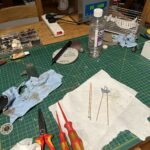
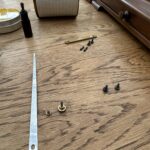
I built a new planter for this 2026 Season. Obviously, I used an overkill of tools and software and lasers, etc…
This year I also used the help of Claude and Gemini to document the overall project for the future Friends and Family or me.
I built a new planter for this 2026 Season. Obviously, I used an overkill of tools and software and lasers, etc…
This year I also used the help of Claude and Gemini to document the overall project for the future Friends and Family or me.
One of the things I keep coming back to is how to explain the impact of compounding in a way that actually lands. Most people have heard about compounding and know it is important, but most just do not really comprehend it.
Numbers on a spreadsheet don’t do it.
The simulator below is built around one simple idea: time is worth more than the amount you save. Put away £200 a month from age 25, and you will have close to £1 million by the time you retire.
The diamond markers show the moment that’s hardest to grasp intuitively: the point where the interest you’ve earned exceeds the money you actually put in. At 9%, that happens at age 39 — just 14 years in. At 4% (roughly the current UK treasury bill rate), it takes until age 57. At that point, the interest itself is working harder than you!!! (This is the actual secret that 99% of people do not grasp despite the fact that it is in EVERY publication about financial management.)
Toggle the savings grow +3%/yr switch to see what happens when your contributions increase a little each year alongside your salary and start compounding themselves. The curves lift dramatically — compounding on top of compounding.
The takeaway: start early, be consistent, and let time do the heavy lifting.
And the subtle addition: if you are not going to save for long, don’t bother, you’re just wasting your time….
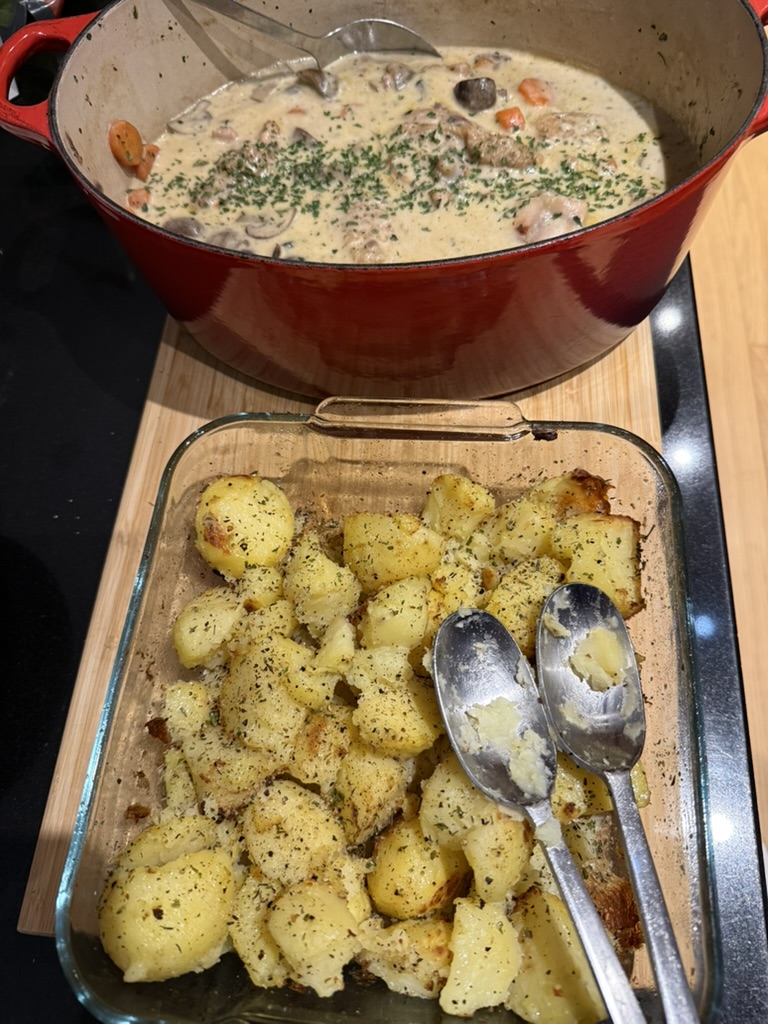
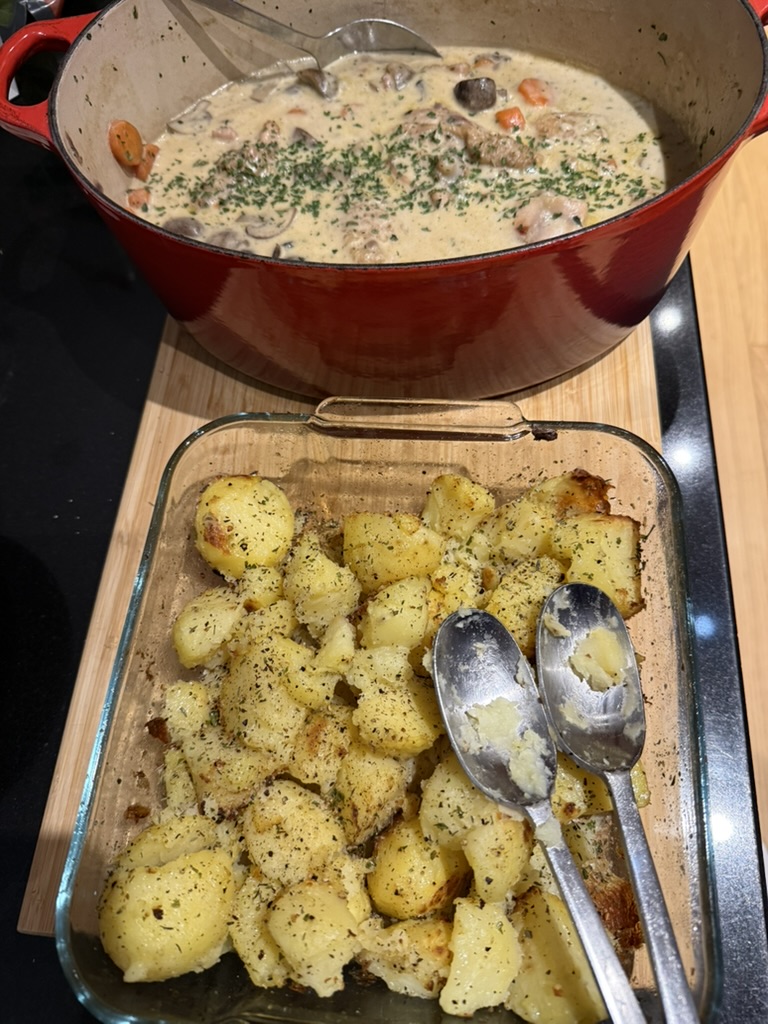
A proper chicken casserole is a lifesaver when the weather turns. This isn’t anything fancy, just good, honest cooking that warms you right through. It’s the kind of dish I grew up with – simple ingredients, maximum flavour.
I’ve tweaked the method a bit over the years to get the chicken skin nice and crisp, which makes all the difference. You brown the chicken at the start, then cook it in the sauce, and finally finish it uncovered in the oven to get that golden, crispy top. Perfect for a weeknight family meal or a comforting Sunday lunch. My recipe does not have tomatoes or tomato puree or celery (which the purist will notice)
This casserole is fantastic served with a mound of roasted potatoes, rice, or just a good, crusty baguette to soak up all that rich sauce. If the sauce is too thin, you can add a spoon of flour or 2 to thicken it.
If you want to make it ahead, cook the casserole, let it cool completely, then refrigerate for up to 3 days. Reheat gently on the hob or in the oven, adding a splash of stock if the sauce has become too thick. It also freezes well for a proper future meal.
I recently hit a milestone: thirty-three years of professional life, and I left Glass Pharms to relax and enjoy life. With the many worries about the potential impact of Artificial Intelligence on the workforce, I reflected on what I would tell my younger self and my kids.
Twenty-six of those years were spent at Xerox, navigating the intricate, high-stakes of a global corporate giant. The last 5 were spent in a completely different world—building a high-tech medical cannabis facility from scratch.
Going from a legacy corporation to a “from-nothing” startup in a highly regulated industry forces you to strip away the fluff. You learn what actually works. I kept a list of principles along the way. I used to call it “The martial art of the office”, but looking back, it’s really just something worth remembering when the pressure is on.
Whether you are managing a billion-dollar budget or building a high-tech greenhouse from a muddy field, the physics of progress are the same.
Move mountains with a spoon: Big projects are an illusion. They are just a long series of small, consistent actions. When the scale feels impossible, stop looking at the mountain and just keep digging. Once in a while, look at what you have achieved and then keep digging. It is true of your savings as well, by the way…it is not about how much but about how long.
Roughly right, but precisely wrong: In a startup or in a corporation, waiting for 100% certainty is a death sentence. I’d rather be moving in the right direction with a rough map than standing still with a high-precision calculation of the wrong path. A monthly budget of 200 lines long, spanning 15 years, is 100% guaranteed to be wrong. 5 well-thought-through pillar assumptions will make your business successful. Never-ending meetings about what we should do next will turn a multi-billion-dollar company into an irrelevant memory of a giant.
The Pig and the Scale: You cannot make a pig fatter by weighing it every day. I’ve seen too many leaders spend more time on the “scorecard” than on the actual work. Action trumps almost everything. I have heard so many times: We must do this, or We cannot fail, or We just need to… True leaders say: How can I help? or This is what I did to move forward. Do…now.
Thirty years will break you if you don’t have a system to clear your head.
Mind like water: In the greenhouse or the boardroom, things go wrong. A “Mind Like Water” means reacting with the exact amount of force required—no more, no less. Don’t let a small leak become a personal crisis. Making a splash is okay if you can quickly bring your mind to a state of peace. Go from Red2Blue.
Build a list, release your mind: Your brain is a processor, not a hard drive. Write it down. If it’s on the paper, it’s not taking up space in your head. Your brain is an amazing pattern detector. Look at your list and search for the pattern. Act on what you notice, ignore the rest. (I actually built an app to do this!…see other post)
The Power of Rewarding yourself: We all have a finite amount of willpower, but you can “grow it”. If you have lots of willpower, it becomes something even more impressive called grit. Grit is required to do extraordinary things. I learned to use a “Click, Routine, Reward” loop to help me increase my willpower and seek control, conscious of my choices, making sure I would reward myself regularly to feed the virtuous cycle. Maybe with an “Oli day”.
For most of my career, I was led to believe “Passion: Yes / Emotion: No.” I was mentored by ill-advised managers who believed that being “professional” meant being a fortress—stoic, detached, and analytical. It was expected of a finance executive in another century.
I was wrong.
Over the last 10 years, I’ve proven to myself that emotional intelligence is a superpower. Most people are staring at spreadsheets or technical specs, completely oblivious to the “human weather” in the room.
If you are someone who feels the tension in a meeting, who senses a lack of integrity before a word is spoken, or who gets a lump in their throat when a team hits a breakthrough—that is your edge. While others are flying blind, your superpower is giving you data. You can make decisions that others think are risky, and you can see the value clearly. Using that sensitivity to address the unspoken is the highest form of leadership. With your superpower, you will not convince but compel. The alpha male in the room might think it is a weakness because you can see through them and embarrass them on their own turf.
At the end of the day, the facility is built, the company is sold, or the role ends. What remains is your character.
Never compromise ethics: In a new industry like medical cannabis or a big corporation, your word must mean something. Once you trade your integrity, you can’t buy it back. You want to be the one everyone agrees is the obvious choice to carry water across the desert. It is a lot harder than it sounds and requires real work. It will sometimes hurt you to do the right thing. It is still worth it overall.
Build a legacy, not a scorecard: People won’t remember your quarterly KPIs from 2014. They will remember how you treated them when things were falling apart. More importantly, they might carry the flag for someone else.
Don’t confuse the “shit” with “the ones shovelling it”: Always respect the people doing the hard, sometimes unglamorous work. They are the ones actually moving the mountain, cleaning up the mess… I faced this many times in the corporate world, in particular. I was lucky, I saw the best and the worst. Both provided compass bearings for my own choices.
To my sons, Jules and Noe: if you take anything from my thirty years, let it be this: You will face “idiotic managers” and “mountains.” You will make mistakes. But if you never compromise your ethics, keep your “mind like water”, and learn to trust that “superpower” of your own intuition, you’ll do more than you ever dreamt of and will have pride in what you built.
Absorb some of this as a sponge and live today like it’s the “good old days.” Because, looking back from many years out, I can tell you—it truly is.
Summer is soon to be with us. Time to get the BBQ going!
Made this super simple calculator back in May 2021, to find out how much gas is left in the BBQ Gas bottles….not that the weather has been any good this year so far…
Almost end of May and very little sunshine, lots of rain…
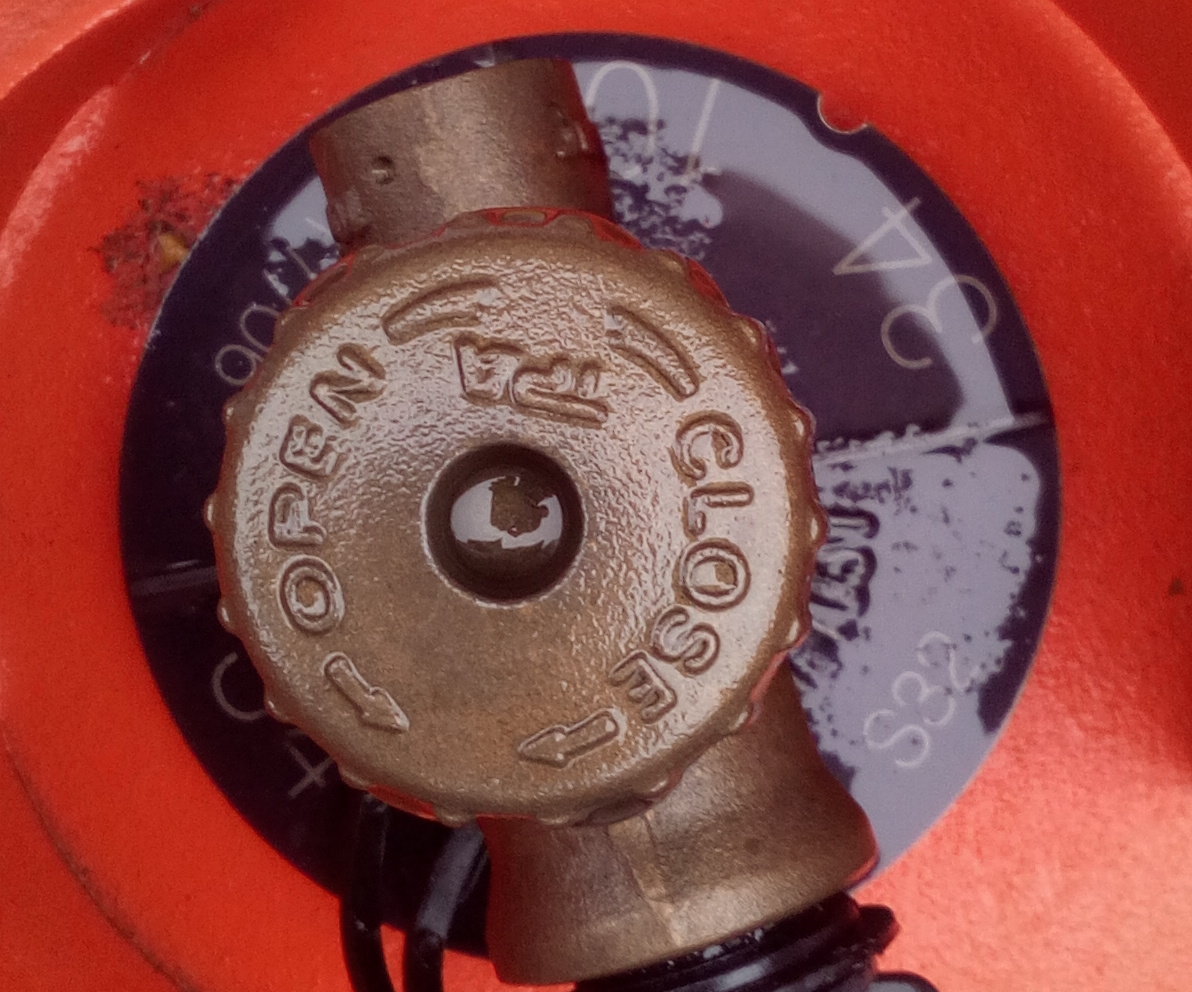
Check the ring first for the 2 numbers (propane or butane bottles have the same design) :
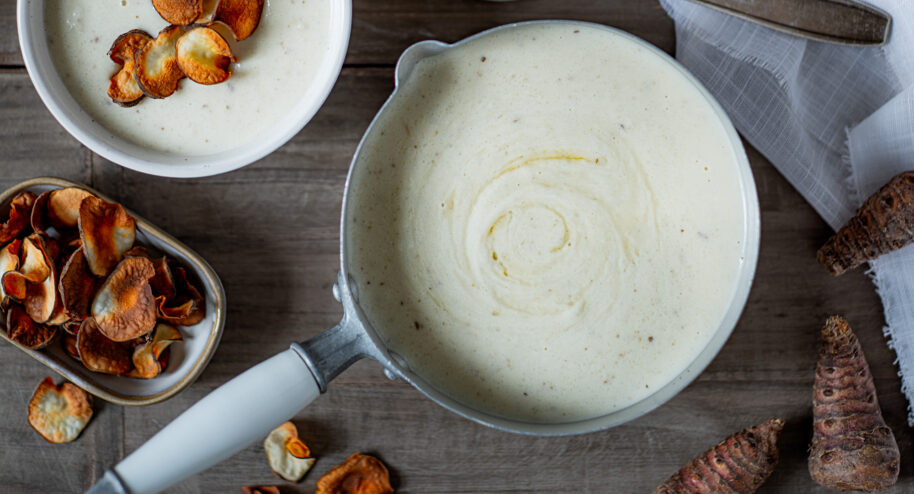
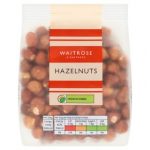
This is “my recipe”; there is no onion, parsley, pancetta, or truffle… which can all be added for a variation on the base recipe, but I still prefer the basic Velouté de Topinambour, where the taste of the Jerusalem Artichokes is well blended with the Hazelnuts and Walnut oil. A Classic at the Dehon’s family dinner.
Ingredients :
How to Make :
A bit of history about the topinambour :
In France, the topinambour is deeply intertwined with the collective memory of the German Occupation (1940–1944).
While they were once a delicacy in the 17th-century French royal courts, their reputation was forever changed by the hardships of World War II.
The Potato Shortage: During the Occupation, the German army commandeered most of France’s potato crops to feed its troops. Potatoes were also used to produce fuel (alcohol) for the German war effort.
The Unregulated Alternative: Unlike potatoes, topinambours were largely ignored by the occupying forces, considered “fodder” for livestock. Because they weren’t strictly rationed or seized, they became a vital survival food for the French population.
Roadside Growth: You are correct about their location. Because the plant is incredibly hardy and invasive, it frequently escaped gardens and grew wild along roadsides, ditches, and railway tracks. For many starving families, foraging these “wild” tubers was one of the few ways to supplement meagre rations.
For decades after the war, topinambours (along with rutabagas) were known in France as légumes oubliés (forgotten vegetables).
“For the generation that lived through the war, the taste of topinambour wasn’t a culinary choice—it was the taste of hunger, occupation, and digestive distress (due to the high inulin content and the lack of other foods to balance it).”
Many survivors refused to ever eat them again once the war ended, and they virtually disappeared from French markets for nearly 50 years.
Today, the topinambour has made a massive comeback in French “bistronomy.” Modern chefs have reclaimed it for its unique, nutty flavour, often serving it as a velvety velouté or roasting it with thyme. It’s no longer seen as a sign of poverty, but as a gourmet winter root.
I’ve tried a few…. Notion, Todoist, Things, plain text files, sticky notes, Google Sheets, Excel spreadsheets. And every time I end up back at the same place: either the app is too complex, and I spend more time organising my tasks than actually doing them, or it’s too bare-bones, and I have to work around it.
So I built OliTick. Not because the world needed another bloated to-do app, which is more of a project management tool than the true “List of things to do that clutter your brain”.
This is the Todo List app. “I” use.
The premise is simple: a clean, focused interface that gets out of your way. No deadline dates, no nested projects, no Gantt charts, no premium tiers hiding basic features. Just your tasks, clearly laid out, ready to be ticked off.
I spent a lot of time on how it looks and feels. I wanted it to be the kind of app where opening it actually makes you feel like you’ve got things under control — not one that quietly stresses you out. Generous whitespace, deliberate typography, nothing that distracts from the task at hand, but still with features that are helpful.
There are a couple of features that I’m particularly happy with:
AI Smart Labels: Type in a task, and OliTick will suggest the right label automatically. It sounds small, but in practice, it means your list stays organised without you having to think about it. The categorisation just happens, quietly, in the background. (It is also voice-enabled)
AI Insight: Ask the AI coach to review your current selection of tasks, and it will review, prioritise and provide you with a suggested attack plan to help you get through your list. You can review and use it or simply ignore it; it is all down to you to decide.
OliTick is in beta right now, which means it’s real and usable, but I’m still actively building on it. If you give it a try and something feels off — or you have an idea you’d love to see — I genuinely want to hear from you. There’s a contact page on the site, and I actually read those messages.
It’s free to use for the basic Todo list, no card required. If you want to use the AI and advanced features like import and export of tasks, you will need a Pro account which is priced purely to help me cover the internet hosting costs.
Give it a go and let me know what you think.
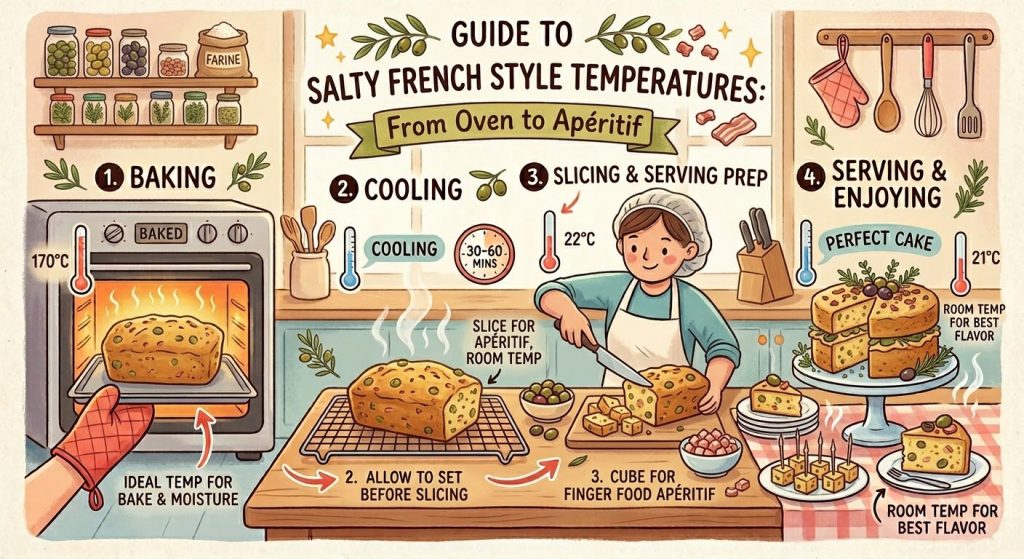
It started with a savoury cake. I was making an olive-and-pancetta cake — that French-style salé cake I have been making for years — and I found myself wondering: how do I actually know when it’s done? A skewer comes out clean long before the inside has fully set, and the colour of the crust isn’t always a reliable guide when there’s no sugar to caramelise.
The answer is a probe thermometer. And once I started thinking about internal temperatures for savoury cakes, I realised I’d never applied the same logic to sweet cakes either. So here’s a guide to both.
Savoury Cakes (e.g. olive & pancetta) Target internal temperature: 88°C – 92°C
Savoury cakes behave differently from sweet ones because their structure is built on eggs and cheese rather than sugar and fat. The egg proteins need to fully set, which means you don’t want to go below around 85°C at the centre — that’s your food safety floor. But push much above 92°C, and you’ll end up with a dry, rubbery crumb, and cured meats like pancetta will toughen noticeably.
One more tip: let your savoury cake rest after baking. It firms up beautifully as it cools and is almost always better eaten warm rather than piping hot straight from the oven.
Sweet Cakes
Different batters have different sugar and fat contents, which shifts the ideal doneness temperature more than you might expect:
| Cake Type | Target Internal Temp | Why? |
|---|---|---|
| Standard Sponge | 98°C – 99°C | Victoria sponges and birthday cakes need to reach this to ensure the structure is fully stable. |
| Fruit Cake | 93°C – 95°C | Very dense cakes with heavy fruit shouldn’t go too high — the fruit sugars can begin to toughen. |
| Chocolate Cake | 93°C – 96°C | Higher moisture and oil content mean that keeping the temperature lower prevents the cocoa from tasting bitter or dry. |
I remember my mum made these in my youth and can remember it was some preparation work and fiddly with the rice paper tearing, etc….
But it was always a success at the dinner table.
I have made a few of these recently for parties with friends, and they are delicious and uncommon.
The wrapping technique below in pictures makes the whole thing a lot easier for the novice.
Ingredients :
How to Make :
I saw this quote today, and it immediately brought to mind the many conversations I’ve had with my kids and friends over the years and more recently, about AI. It is a sentiment I feel strongly about—and if I’m honest, it’s a concept that carries a bit of fear for me.
“Standing still is the fastest way to go backwards.”
In a world defined by exponential technological growth and constant shifts in industry, the “ground” beneath us is always moving. Whether it is the evolution of high-tech or personal growth, the pace of change is accelerating.
One could think of this in terms of relative depreciation. If you aren’t actively appreciating—learning new skills, tinkering with new tools, or evolving your mindset—you are effectively losing value against the rest of the world.
Standing still isn’t a neutral act; it is a choice to let the gap between where you are and where the world is headed widen. It is important to realise that the choice is ours and that, in my opinion, both paths are equally acceptable, even if the external pressure of the “norm” is to join the rat race.
In my career (corporate and as a founder), I have seen people move fast without any direction more than once! Those individuals (and the world in general) would have benefited from them standing still…
I often use:
“A wave is coming…you can duck it or decide to surf it…”
Whatever you do, do it with intent.
If you’re looking for me …I am out playing in the waves…

A side-by-side comparison of the key nutritional profiles for energy performance and immune support.
| Nutrient / Ingredient | Berocca Energy | Tonic Daily Immunity |
|---|---|---|
| Vitamin C | 500 mg | 1,000 mg |
| Vitamin D3 | — | 50 μg (2000 IU) |
| Vitamin A | — | 1,200 μg |
| Vitamin B-Complex (B1, B2, B3, B5) | High Dose (Avg 25mg+) | — |
| Vitamin B12 | 10 μg | 2.5 μg |
| Zinc | 10 mg | 10 mg |
| Selenium | — | 100 μg |
| Magnesium & Calcium | 100 mg each | — |
| Reishi Mushroom Extract | — | 1,500 mg |
| Sweeteners | Aspartame / Acesulfame K | Stevia (Natural) |
A new 2026 recipe to try for burger buns….
hummm… i tried this during the weekend and it was not a success ! I used a plain flour and maybe the yeast was not good anymore, it did not rise after hours of waiting.
The result was average
I think there was way too much butter. I might research a bit more the standard recipes for brioche and compare.
Ingredients :
How to Make :
Another recipe from friends visiting us in London. This time, I tried the Thermomix function that lets me create the full recipe on the Cookidoo platform, so anyone with a Thermomix can now make this recipe.
The shortcrust pastry is upgraded with some ground almonds, which make it velvety.
Ingredients :
How to Make :
The powder of the almonds can be discarded or used for other purpose such as Almond flour. I have tried to make some Almond flour but it is not my thing…
This is actually a lot easier if you can source the raw ingredient from a quality source.
In particular, if you can buy a fresh de-nerved foie and have a temperature probe.
Ingredients :
How to Make :
When serving to eat, take the foie gras out of the fridge 30 minutes beforehand so it can be sliced more easily.
Serve with bread and a sweet wine like a Montbazillac or a Sauterne.
Ingredients :
Frangipane :
How to Make :
Petits moments partagés, grands souvenirs — et une recette qui restera!.
We had Heidi at the house for a week, and it was such a pleasure to share some relaxing time and get to know each other better.
It felt special to reminisce about how her dad and I lived together at my parents’ house nearly 40 years ago, and now, all these years later, his daughter spent a few lovely days with us. Family is truly precious — and creating new memories together is even more special.
Even though her stay was short, she made the most of it, with visits to London, a local pub quiz with Manu, and some great evening chats all together.
She also shared her crêpe recipe, which I’m saving here for future use. From now on, it will be known in our house as Heidi’s recipe… even if it originally comes from a classic North American cookbook, The Joy of Cooking.